THE MESS IS THE WORK
~ 4 min read
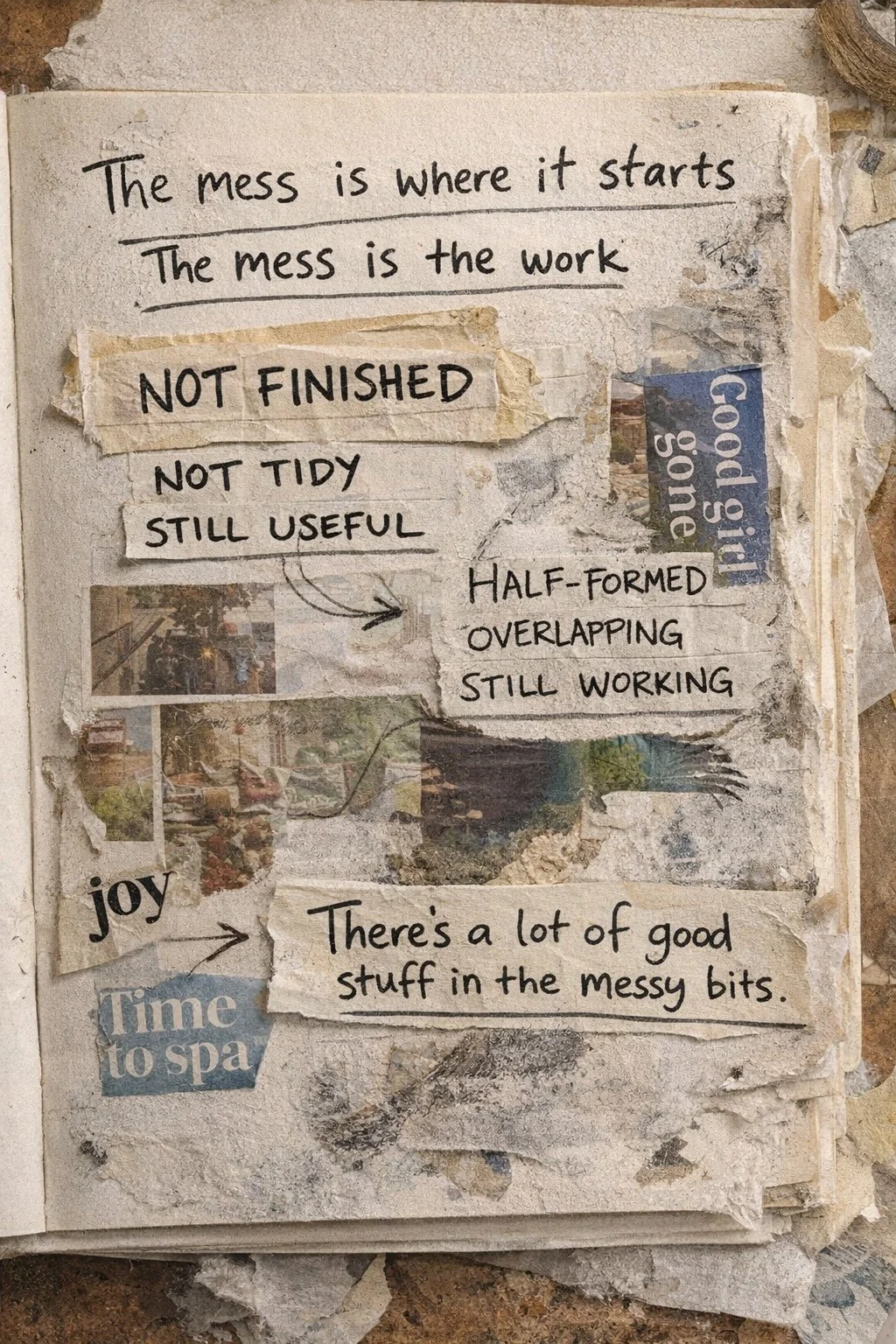
It doesn’t always come in a straight line.
That doesn’t mean it’s not working.
From the outside, it can look like nothing is happening. Or like too much is happening all at once. There isn’t a neat version of it yet. Not something you can easily point to, package up or pitch in one clean sentence.
At this point it’s not quite:
project name + what it’s about + why it exists = who it’s for
If anything, it’s more like:
mess + time + people + trying things out = something (eventually)
It’s still shifting. It’s not ready to be pinned down or stapled to the wall. Yet.
And that’s the bit we’re usually taught to skip past. To tidy up.
To turn into something clear and easy to grasp.
Something you can explain, hold up and say, “this is it”.
We’re trying not to do that too quickly.
Not to apologise for the unfinished version.
To talk about it as it is.
To stand in it a bit longer.
To be proud of the mess. The pro-mess pro-cess.
For us, It looks like this.
Notes everywhere.
Cars loaded with workshop gear for weeks.
Sometimes weeks after things have finished and we still haven’t made it to the lock-up to unload.
Props borrowed from home so there are odd gaps where things used to be.
Crates becoming tables. Things not quite put back yet.
Props and half-made things.
And cups. So many cups.
Lists that keep growing faster than we can finish them.
Things getting added as quickly as they’re crossed off.
You don’t ever really reach the end of the list.
And maybe you’re not meant to.
There isn’t really a finished list anyway.
Just different points along the way.
Some things done. Some things never completed.
Always something else to add.
And we don’t always choose the right things to cross off.
Or we stick with the same kinds of things because they’re ‘easier’, ‘clearer’ or more ‘urgent’ to finish.
You can spend a whole day / week / month doing that.
Moving through the list. Getting things done.
And still feel like you’ve not quite got to the work underneath it.
Then, at some point, you leave it.
Or you try to.
Come back to it later.
Or start something else alongside it.
And somewhere in that, you learn when to put the list down altogether.
Or at you least try to.
You press pause.
And rethink what goes on the list in the first place.
Because it can’t all be the work.
It has to include the things that feed it.
That feed you.
Time away.
Space.
Doing nothing for a bit.
Un-guiltily.
We’re getting a bit better at adding those things to the list too.
Or at least we’re trying to.
In the mess, it always feels a bit:
Chaotic.
Mischievous.
Scary.
Exciting.
Ideas getting pulled in from all directions.
Things overlapping. Things repeating.
Things that felt right yesterday not quite landing today.
This is the bit that can feel uncomfortable. Because it doesn’t look like progress in the way we’ve been taught to recognise it. It doesn’t look neat. It doesn’t line up. It doesn’t resolve. It doesn’t have an end.
But it is the work.
It’s where something starts to take shape, even if you can’t quite see it yet.
And it spills out into everything. Homes become part of it for a while. Bags stay half packed. Conversations loop. You start noticing things differently. Little details. Fragments. Bits of language. Things that might be nothing. Or might be something.
Then, slowly, something shifts.
Not all at once. Not dramatically. Just a little bit at a time.
The car gets unpacked.
The things borrowed from houses are returned.
But now with new stories.
We make a bit of space again.
Not tidy. Just calmer.
Enough to see what’s there.
Enough to keep going.
Some things we’re trying to help with the mess while still staying in it.
Might be useful. Take what’s helpful. Add your own.
Putting “do nothing” on the list and actually doing it.
Not always literally doing nothing. A walk, a coffee, a proper chat, a change of scene. And trying to do it without guilt. There’s that whole idea of different kinds of rest, not just stopping but restoring in different ways (physical, mental, social, creative…). Worth a look if you’ve not come across it before.
7 Types of Rest by Dr Saundra Dalton-Smith
https://ideas.ted.com/the-7-types-of-rest-that-every-person-needsRemembering the work doesn’t have to happen between 9am and 5pm.
Freelancers… we know oh-so-well the 9am guilt train (or the 10am to midnight one…). Remember the work can happen on a walk, in the shower, mid-conversation, halfway through something else. You can shape your day around how you actually think and work. Your energy. And yes, we know this is easier said than done. School runs. Life. Everything else that has to fit in.Accepting that something that worked yesterday might not today.
And that doesn’t mean it’s gone wrong. Sometimes it’s just: pause, shift it, come back differently.
Or leave it and try again later. We sometimes “turn around and touch the ground” just to shake it off and reset for a minute. It helps. Honestly, it does.Noticing when you’re only doing the easy-to-finish things.
We do this a lot. Sometimes a timer helps (pomodoro, time blocks, all of that). Sometimes it absolutely doesn’t, especially if your brain doesn’t work like that. So it’s more about noticing when it’s happening… and gently nudging back to the thing that actually matters. The thing that needs your energy. Your attention.Coming to terms with the fact that lists don’t end.
And deciding what’s enough for today. Not finished. Just… enough. And also remembering the list isn’t just what you have to do. It’s what you want to do as well. The work. The life. The bits that refill it. Otherwise it just becomes a list you’re trying to get through, not one you actually want to be in.Sometimes stepping away from the list entirely.
Wash some dishes. Have a mini dance break. Sing. Then come back to it later. Usually clearer.And sometimes just putting the damn cups away.